Leslie Falconer MacDonald:
Pioneer Bristolian Aviator and Cathedralian
Bristol is really known for three things: being a harbour city, as a former world renowned aviation hub and somewhere whose people always get their voice heard.
Leslie Falconer MacDonald (1890 - 1913), a local Bristolian lad and Cathedralian (BCS c.1903-1908) (see picture below) is connected to the second of those. Whilst the invention of the aeroplane and the dawn of manned fight can be traced elsewhere to the USA and aviators like the Wright Brothers, it is reasonable to date the genesis of the aviation industry to Bristol and the British and Colonial Aeroplane Company founded by another local, Sir George White, in the Filton suburb of the city in 1910 - a craft that continues there to this day. Leslie, one of four sons of James and Olive MacDonald, pursued engineering as a career after finishing at Bristol Cathedral School and it may well be fair to say it was a family affair as his father's career was in railway company management. Having first worked for Bristol Wagon Works, MacDonald later moved to Bristol Tramways and Carriage Company's motor department.
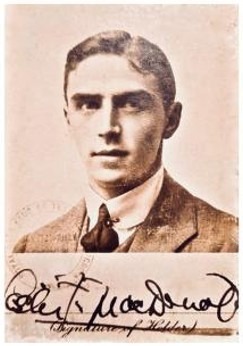
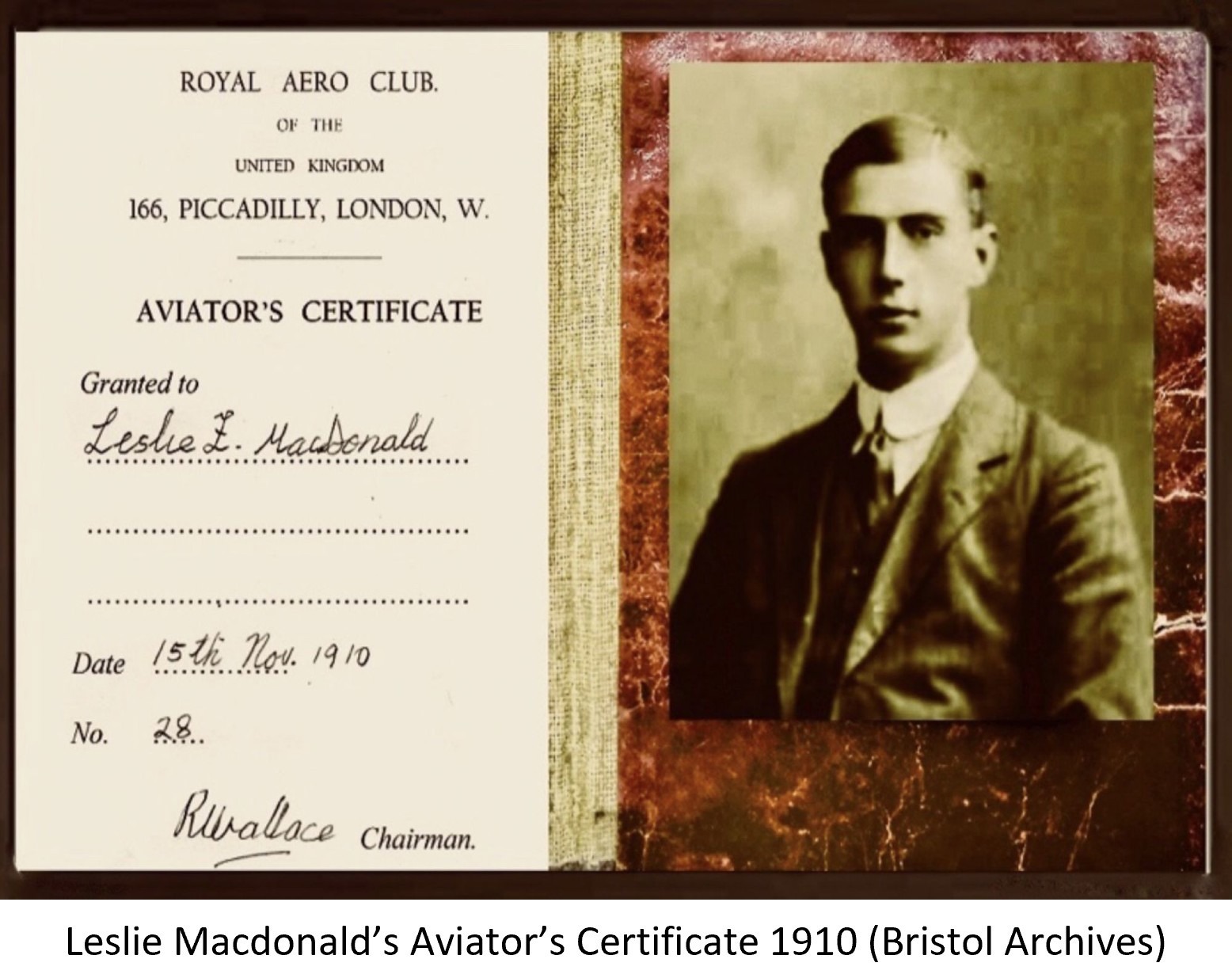
Signed flying licence photo of Leslie MacDonald (Bristol Archives)
This would be the beginning of Leslie's path to the skies as Bristol Tramways and Carriage Company was Sir George White's original foray into public transport, and led to White - always staying ahead of the times - founding the British and Colonial Aeroplane Company to pursue his interest in the fledgling but burgeoning area of flying machines.
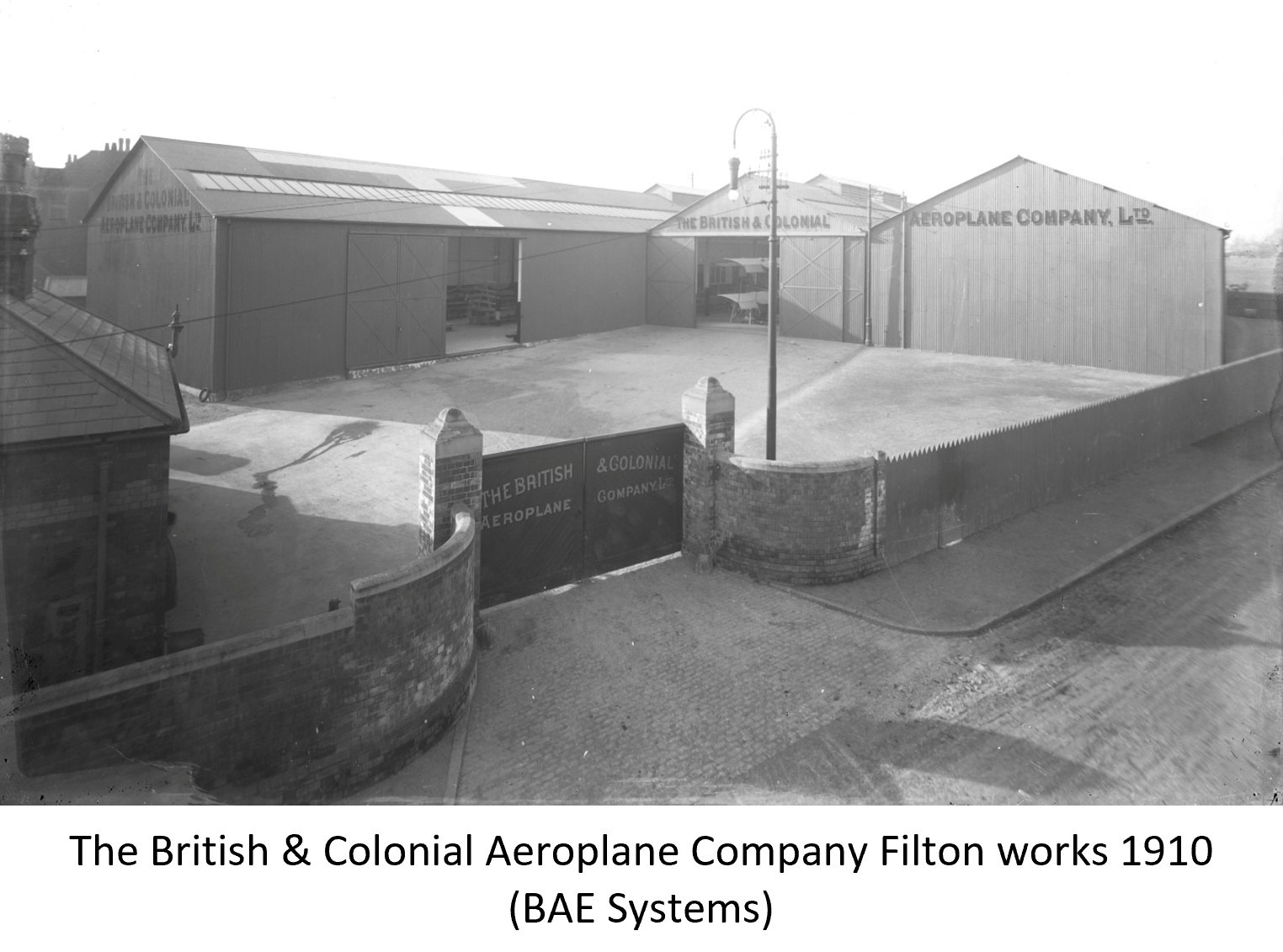
MacDonald transferred to new aeroplane works (see picture below), where his engineering skills were no doubt a natural fit, and quickly set about getting in the air himself. He encountered the company's very earliest projects, including their first in house design and the machine that he would fly into the history books - the Bristol Boxkite.
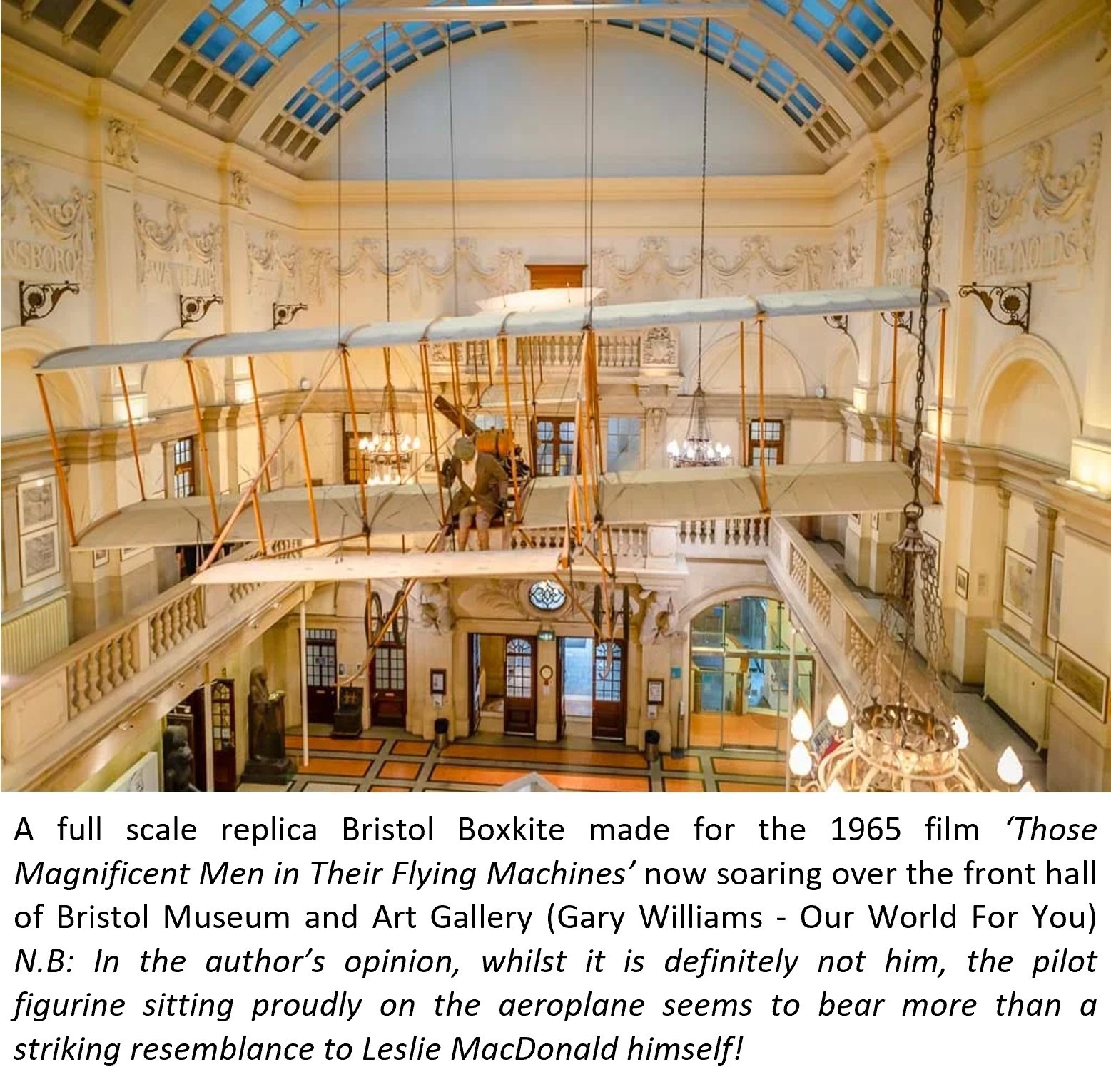
Alongside the nascent Bristol works the company set up Bristol branded flying schools, one in Larkhill and one in Brooklands, with MacDonald the first to qualify from the latter (and 28th overall in the country) as well as the first to do so using a Bristol aeroplane - a Boxkite on the 15th of November 1910 (see pictures below of MacDonald's flying licence and a replica Bristol Boxkite).
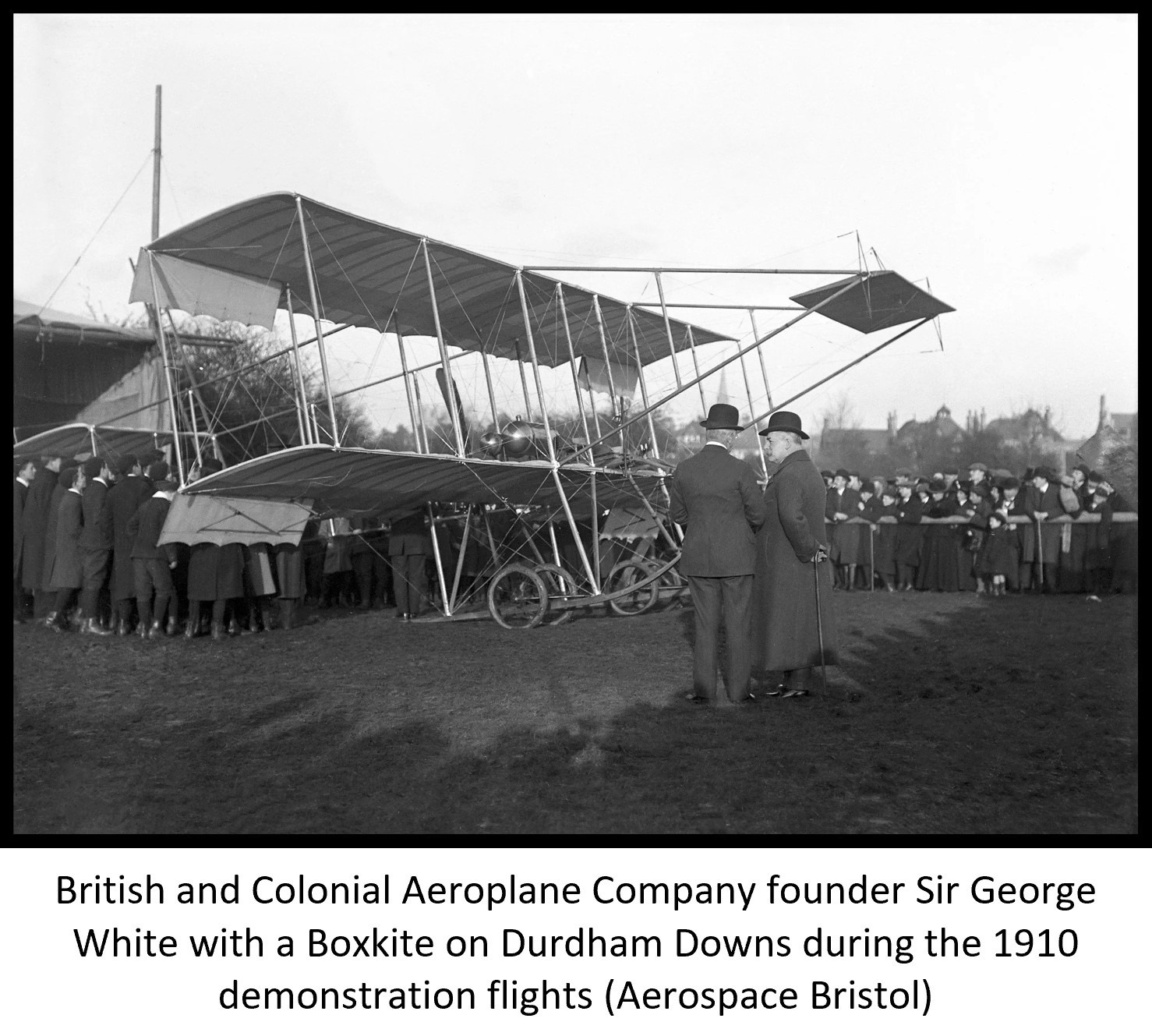
At the same time MacDonald was on Durdham Downs in Bristol setting up and flying two Boxkites as part of the first citywide demonstration of these newfangled flying machines by the company between the 11th and 16th of November 1910. On Friday the 11th of November he tested one of the aircraft, in typical Bristol conditions - heavy rain, over three flights, the last of which accompanied by a patron and thus MacDonald became the first person to fly a Boxkite over the Downs both solo and with a passenger.
From there French pilots Maurice Tetard and Henri Jullerot went on to conduct the main tests over the next few days to great acclaim for the company while MacDonald travelled to Brooklands for his flying test (see picture below of main flights with Sir George White in front of the aircraft as no images remain of MacDonald's tests in the days before). Off the back of the successful demonstrations the company put together two different sales missions, both military focused, one to India and one to Australia and New Zealand; Sir George recognising and marketing the potential of flying machines for defence - something first discussed with the UK government but their response proved slow and sceptical to the new technology. MacDonald was chosen to go on the Australia and New Zealand trip in December 1910 as an engineer alongside principal pilot Joe "J. J." Hammond where they flew two Boxkites over Perth, Adelaide, Melbourne and Sydney in the spring of 1911. Sadly no order was forthcoming from the Australian military authorities as they too proved hesitant and questioning of the new machinery. However, in the lull between the completion of the various test flights and the Australian armed forces making up their mind, MacDonald would achieve his other major 'first'…
Sydney local William Ewart Hart, upon observing Boxkite test flights over the city, became aware that the aircraft might be for sale and negotiated a purchase with MacDonald. By this point Leslie's colleague J. J. Hammond had left Australia for his native New Zealand meaning MacDonald was left in charge of the mission with a view to returning to HQ at Filton. In the event MacDonald stayed on in Australia for most of the rest of 1911, overseeing the deal with Hart, helping him assemble the aircraft in a natural area of parkland (what we might now call an aerodrome) in Penrith on the outskirts of Sydney and teaching the Australian to fly the Boxkite. This Boxkite was the first aeroplane owned in Australia and Hart would go on to secure Australia's first flying licence in December 1911.
MacDonald was recalled by the company, possibly in trouble for going beyond the sales mission parameters, and returned not long after Hart had gained his licence. Hart was Australia's first aviator and so it can reasonably be said that MacDonald, a Cathedralian, was the first person to bring aeroplanes to Australia. Sadly McDonald's life was cut short only 2 years later in January 1913 - at this point working as a test pilot for the aviation department of Vickers engineering company - when he and mechanic Henry England crashed in the river Thames while flying a new two seat Vickers No.6 biplane and both men drowned with MacDonald tragically not knowing how to swim. His funeral was held in February 1913 at Canford Cemetery in Bristol with a large turnout not only from British and Colonial and Vickers from the aviation world but also Bristol Tramways and Carriage Company which provided the hearse car and mourner transport. Moreover many of his classmates at Bristol Cathedral School attended with dozens of wreaths laid at his final resting place, including one on behalf of the, at that time newly formed the previous year, Cathedralian Society, which read "In Loving Memory of Leslie Falconer MacDonald, a martyr to science".
In terms of the wider picture, with the success of the Durdham Downs Boxkite flights, and the Indian and Australasian sales trips, the company had been brought to the world's attention and would go on along with its successor entities such as the Bristol Aeroplane Company and British Aerospace, to soar the skies as pre-eminent players in the UK aerospace industry for many years. Bristol itself would become a world leading aviation hub during the Second World War and perhaps it, and Filton's, most famous day was as the British hub of the Anglo-French Concorde project in the 1960's. Today aerospace is still in Filton through a number of firms that all link back to the British and Colonial Aeroplane Company. None of this would have been possible without the influence of many people, and alongside the likes of company founder Sir George White, that very much includes pioneers like Leslie Falconer Macdonald…
Floreant Cathedraliensis!
The Final Word: MacDonald's first Boxkite flights over the Downs will be commemorated with a blue plaque to be unveiled on Thursday 30th of July 2026 at noon at the Downs Café (Address: Durdham Downs, Stoke Road, BS9 1FG) by the Bristol Civic Society including Cathedralian Society President Charlotte Paramor and Council Member Duncan Gaffney as part of the formal ceremony party.
This is a reissue of an article put together when MacDonald's story was first brought to the society's attention back in 2022 at the publication of a book on the Australian aviator William Hart and its release is timed to coincide with the upcoming blue plaque ceremony to which there is an open invitation for all Cathedralians!
|